
I did it. I finally gave in and purchased Sagebooks 500. With the high price tag, it took a lot of consideration. How can Sagebooks charge so much for these books?! The answer is: Sagebooks are magic, sorcery even! Why are these books magic? Because they got my uninterested 4-year-old interested in learning Chinese again! If you’re raising a bilingual child and searching for a way to teach them to read Chinese, you’ve probably heard of Sagebooks 500. In this ultimate guide, I break down everything you need to know and share my honest experience. If you’re on the fence about buying, this guide will help you decide.
Our Chinese Learning Background
Ours is a familiar story. I’m a second-generation Taiwanese now learning Chinese along with my newly 5-year-old son and 2-year-old daughter. A year ago, I naively thought I could do this Chinese thing without dropping a bunch of money. We would just read and use flashcards. Right? Up till now, my son has learned about 50 characters through various games and activities. He does not like to write. He loves books but dislikes learning to read in Chinese or English.
The trouble began when my son started Mandarin Immersion preschool. He went from speaking only Mandarin to speaking English and refusing to speak Mandarin. This is a common problem that we will all face at some point. I think when he saw other Asian kids speaking English, he realized that he didn’t HAVE to speak Mandarin. At the time, he was the only student at his Mandarin Immersion school who spoke Mandarin. He needed to speak English to communicate with his classmates. Asking him to speak Mandarin only fueled his resistance to Chinese.
A few days before our Taiwan trip, he got very upset and said, “I don’t want to do Chinese anymore!” I was crushed, so I decided we could take a break from learning Chinese Characters and just enjoy our time in Taiwan without any pressure. Both kids were back to speaking only Mandarin after about 2 weeks into our trip. It helped that they were enrolled in a local preschool. You can read more about our Taiwan preschool experience.

Why I Decided to Buy Sagebooks
We’ve all read the same testimonials about how Sagebooks taught a fetus how to read while still in the womb. But I was convinced after meeting moms in real life who agree that Sagebooks is an easier way for your kids to learn Chinese characters. Let’s get this straight, though: easier does not mean easy or without any effort. Plus, I was in Taiwan at the time and saved $100 on shipping alone!
I ordered the entire Sagebooks 500 and Treasure Box books. My luggage was 18 pounds heavier, while my bank account was $472 lighter. If you plan to buy Sagebooks while abroad, the books arrive in two separate boxes and take up almost my entire suitcase. Sage Formula includes the complete set of 25 course books, 25 treasure box books, and 10 CDs that go along with all 50 books.
Intro to Sagebooks with my 5-year-old
Upon opening the box and pulling out the first book, my son was very excited and said, “我要自己念/I want to read on my own!” He pointed and giggled at the primitive childish drawings. As he curiously flipped through book 1, I pulled out my phone and started recording. To my surprise, he was able to read quite a bit on his own. After a 3-month break from learning Chinese characters, he was still able to retain much of what he learned before.
It took us a week to get through book 1. We will continue to go over book 1 until he fully learns all the characters. He has 4 characters he still has a difficult time with. We are moving very slowly because I don’t want Sagebooks to become a burden. I try to read with him once a day but move on to storybooks if I sense he is feeling stressed.
Intro to Sagebooks with my 2-year-old
My daughter usually plays nearby while we do any Chinese learning activities, or participates if she wants to join us. I’m focusing so much on my son’s learning because he is having a hard time. While we were reading, he got stuck on a character, and my daughter chimed in and read for him. The other day she stayed home from school with a cold, so I decided to really see how much she could read. I can’t believe she has learned just as many, if not more, characters than her big brother. It’s true that children are so different and have to learn at their own pace.
The way Sagebooks designed the lessons is so intuitive. My daughter instinctively uses her index finger to trace the character strokes. The first time seeing the character page, she said, “媽媽。 我要用手寫字/mommy, I want to write the character with my hand”.

How We Started Learning With Sagebooks 500
While repetition is key to really knowing the characters, we also do other activities to keep the learning process fun and interesting. During the 15-minute ride to school (when we carpool with Dad), I go over flashcards with them. I bought the c-pen flashcards because we already have the pen for other books. I turned it into a game by holding up the card, and whoever says the word first wins. Most of the time my 2-year-old wins. I’m betting on my son’s competitive nature to push him to focus, but it’s not working so far. Other times I make up funny phrases with the flashcards.
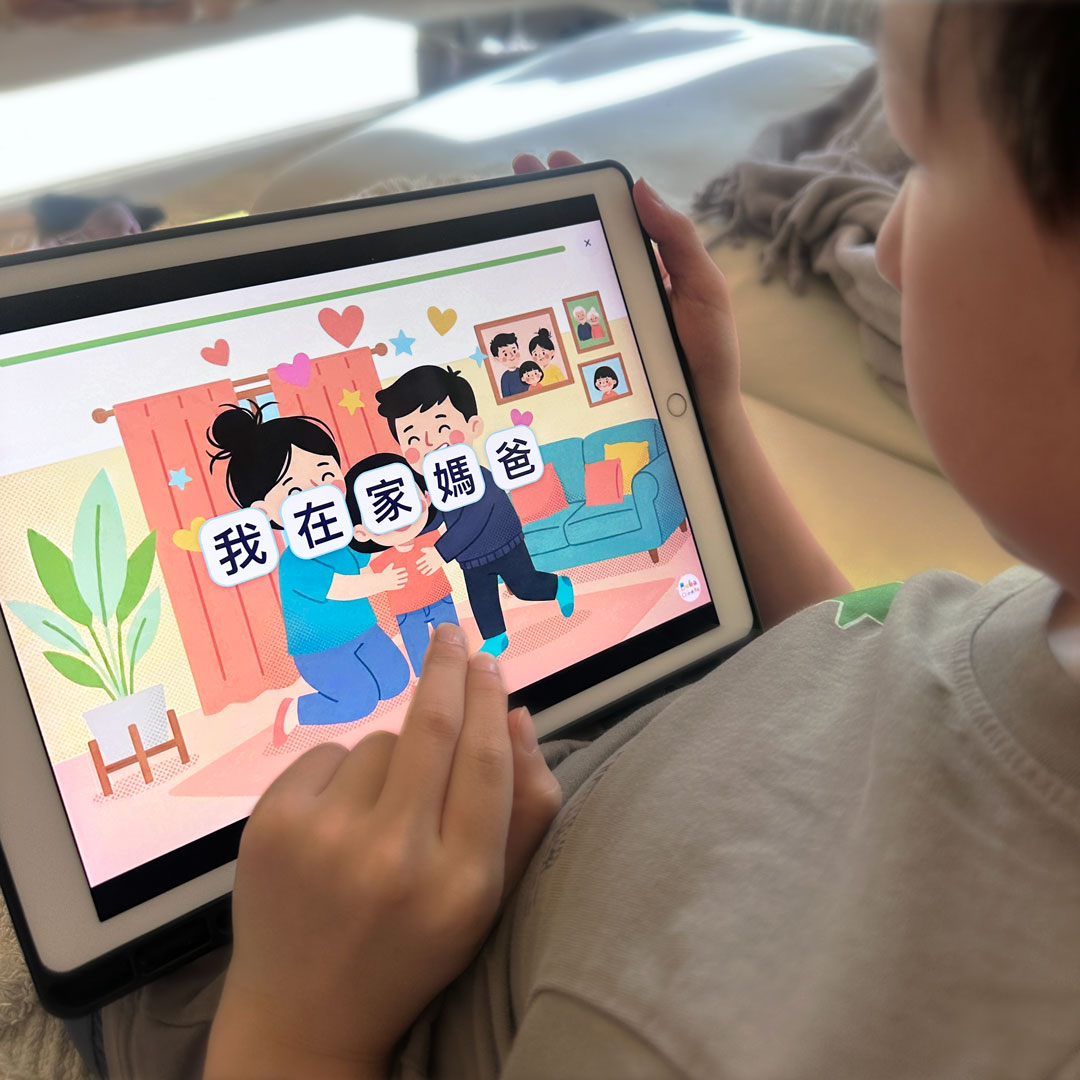
My son was having a hard time with 我. I set up a matching game on their art board. He had to complete the sentence using characters written on sticky notes.

Meal times are a great opportunity to learn. I like to write Chinese characters on their plates or make the Chinese characters out of food. Pancakes are always fun!
To get him to write, I created a light box with an iPad and a sheet of paper. I used the Google Translate app, zoomed in on the characters, then locked the screen. My son usually refuses to write but happily traced the characters. When I asked him why he was willing to write, he replied, “因为好酷啊!/because it’s so cool!”

500 Tracing Worksheets for Sagebooks 500
Eventually, I decided they needed more than 10 minutes of reading Sagebooks to learn the characters. I created 500 Sagebooks worksheets to trace the characters and practice writing. These tracing sheets are intentionally designed without bright colors and distracting illustrations. I also created some word search worksheets for fun!

How To Make Sagebooks Fun
We are a crafty family and incorporated DIY activities into our Chinese learning. I really believe that being involved in creating activities sparks a deeper interest. Some of the games we made include a night market shooting game, drumming activity, and action cubes.
We are also a foodie family, so naturally I incorporate Chinese into mealtime as well. In addition to the character pancakes at breakfast, you can decorate cookies or use food to create simple characters. Just be creative! I often use ketchup to write characters on their plates.
I’m learning along with them, and setting up these activities helps with my character recognition too!

More Sagebooks Learning Resources
Create Chinese Storybooks With AI
There are so many Sagebooks resources in addition to the games and worksheets that I’ve shared. With the advancement of AI, you can now create custom stories for your child. I prefer to use DeepSeek (a Chinese AI Company) to create the Chinese story. Then I use Google Gemini to create the illustrations. I share my prompts in the screenshots below.


Free Worksheets and Sagebooks Character Assessment
How do you keep track of your child’s Sagebooks progress? You can use the Mandarin Homeschool Assessment Guide to check your child’s character recognition. You can also download many free Sagebooks worksheets from EdKids. You can even create your own resources with these free worksheet generators, but why spend the time when we’ve got you covered?!
Sagebooks 500 (基礎漢字500) FAQ
What Is Sagebooks 500?
Sagebooks is a Hong Kong-based educational publishing company that produces a flagship Chinese reading curriculum called Sagebooks 500 (基礎漢字500). Available in both Traditional and Simplified Chinese, with Mandarin and Cantonese audio, plus Pinyin and English translations.
The curriculum itself is a physical set of books—specifically, 5 boxed sets, with 5 books inside each box, for a total of 25 books. Each book introduces 20 new characters, gradually building toward a total of 500 most commonly appearing Chinese characters in children’s literature.
When your child finishes Sagebooks 500, they should have solid recognition of 500 high-frequency Chinese characters, enough to read children’s books, menus, and signs!
Who is Sagebooks 500 For?
This curriculum primarily targets preschoolers and early elementary students, roughly between the ages of 3.5 and 6.
It works exceptionally well for heritage learners who already speak Mandarin or Cantonese at home. For non-heritage families, Pinyin and English help parents who don’t read Chinese guide the lessons.
Parents often report that kids lean too heavily on the pinyin. Not to worry, create a reading strip with a document sleeve and masking tape. Here’s the easy reading strip tutorial.

Which Chinese Characters Does Sagebooks 500 teach?
Below are side-by-side lists comparing the Traditional Chinese characters and the Simplified Chinese characters in the Sagebooks curriculum. About 27% of the characters are simplified.


How do you use Sagebooks 500 to teach Chinese?
The publisher recommends a daily 10-minute session. Here’s a proven routine:
- Open one book from the set and point to the new character. Say it aloud and have your child trace the stroke order with their fingertip.
- Use my Sagebooks worksheets to support the Sagebooks curriculum. They are specifically designed for young learners to trace the characters.
- Memorization Hack! If you think they are memorizing instead of reading, have them read backwards. This forces them to focus on the characters.
- Make it fun! Play games and activities to help get them excited about learning Chinese!
- Celebrate small wins. Many families use progress charts to mark off each character, giving kids a visual reward for their efforts.
How Long Does It Take to Complete Sagebooks 500?
The publisher recommends a one-lesson-per-day pace, which would put completion at roughly 1.5 to 2 years. But in reality, every family’s timeline looks different.
My own kids took 3 years. At first, I felt embarrassed seeing other parents post about finishing in record time. But after chatting with other moms, I realized our pace was actually quite common. Many families take 2–3 years, especially when starting young or balancing multiple languages.
It’s not uncommon for parents to give up after the first couple of books, which is why you can find so many pre-owned Sagebooks sets online that look practically brand new. The program requires daily commitment, and it can feel quite boring. My son complained so much!
If your child is progressing slowly, don’t be discouraged. Every child learns at their own pace. The goal isn’t to race through 500 characters; it’s to make sure they have a solid foundation.
What Is the Sagebooks Treasure Box (寶貝盒) and Should I Buy It?
The Treasure Box is a companion storybook set designed to be used alongside the Basic Chinese 500 curriculum. Reading Treasure Box books helps to reinforce the Sagebooks characters through engaging stories.
Some parents recommend buying the Treasure Box, but many also say they don’t like the stories. We tried to read Box 1, but my children had no interest in the stories. For our family, these were a waste of money.
Where To Purchase Sagebooks 500 and How Much Do the Books Cost?
The official Sagebooks Hong Kong website ships internationally.
The Sagebooks 500 complete set costs HK$2,475.00 ($315.60 USD)
The Sagebooks Treasure Box set costs HK$1,188.00 ($151.49 USD)
In North America, try Little Kozzi (Canada). However, they are often sold out.
For budget-conscious families, check out the Motherly Notes Facebook Group for Chinese Books. You can find great deals on pre-owned Sagebooks 500 sets. I see many listings with only one set open!
Is the Price Worth It?
If your child successfully learns 500 Chinese characters for the price of the set, $315, that is the steal of the century!
The resale value of the books is high, especially if you keep them in good condition. I paid $472 and had to haul them back from Taiwan. I was able to sell Sagebooks and the Treasure Box set for $450!
Sagebooks 500 vs. 四五快读 vs. Le Le Chinese: Which Program Is Right for Your Child?
If you’re researching Chinese reading programs, you’ve likely come across these three names. Each takes a different approach to teaching children to read Chinese characters. Understanding these differences is key to finding the right fit for your family.
Overview: Three Different Philosophies
Sagebooks 500
Introduces characters one at a time in short sentences, building recognition through repetition and clear progression. The focus is on mastering 500 high-frequency characters through consistent daily practice.
四五快读 (Si Wu Kuai Du)
Affordable, widely-used Chinese reading curriculum developed over a decade of research and refinement. It’s designed to teach 40-50 characters early on to enable independent reading quickly. The name itself means “four-five quick read,” hinting at its goal of fast progress for 4-5 year olds.
If your child is learning simplified Chinese characters, 四五快读 (Si Wu Kuai Du) is available in Simplified Chinese only. It’s not a questions of which curriculum to buy. You could use Si Wu Kuai Du as the main textbook and Sagebooks as a reader to practice and reinforce the learned characters.
Le Le Chinese
Rather than drilling characters in isolation, children learn through 300 leveled picture storybooks organized into three color-coded stages (Red → Yellow → Green). Children read progressively more complex stories and learn characters naturally through repeated exposure.
This set is only available in Traditional Chinese. The included reading pen offers instant feedback with Mandarin audio, as the books do not have Zhuyin or Pinyin.
We started Le Le Books after completing Sagebooks. While Sagebooks teaches a core of 500 characters, the full Le Le system introduces over 1,000 Chinese characters.
Le Le Chinese is designed to build reading stamina. As the child progresses through its three color-coded levels (Red → Yellow → Green), the stories become longer and more complex, strengthening reading comprehension and stamina. The 300 stories in the complete Le Le set provide a gradual ramp-up, reinforcing characters in diverse contexts and preparing children to read longer texts.
Use my discount to get a discount on Lele Books with promo code:
mamababymandarin


10 Comments
Great post! thanks for sharing your journey! Always helpful to hear other parents experiences with it.
What do you use to write those food characters for your kids?
I use a really small squeeze bottle like this one https://amzn.to/2LGKKHi. You can also use an icing bottle like this one that I use for my pancake art https://amzn.to/3563Qyy
Love this! (I’m just exploring this stage of the journey now). Curious, since my kids are learning bopomofo– I was concerned that the pinyin would add a level of confusion. Also, since they are also learning to read English. Have you or known anyone to have this concern?
It’s a common concern with parents when they begin to teach characters. My kids have never been confused by Zhuyin, Pinyin, or the difference between Simplified and Traditional characters. Once your child starts learning to read in English, it can become an issue when they are reading Pinyin instead of the Chinese Characters. All people are different though, so I cannot say 100% your child will not be confused, but from the feedback of many parents, it doesn’t seem to be an issue.
Hi Jeanne, did you teach your kids zhuyin before doing Sagebooks? I’m wondering whether it’s worthwhile to teach the kiddos (oldest in K) zhuyin or just go right into learning the characters. Thanks in advance for your feedback!
We jumped straight into learning characters. My kids still have not learned Zhuyin but it’s my goal to have them learn it so they can read more of our book independently.
[…] heard about Sagebooks from Chalkacademy and Mama Baby Mandarin, and I have been debating whether or not I should get it for my kids (2.5 and 5 years old). […]
My 6-year-old just finished Sagebooks! I’m so proud of her. My son has two more books to go. Sagebooks is not perfect, but it does offer a more structured way to teach 500 characters. I have yet to find an easier way.
[…] Mama Baby Mandarin – Sagebooks […]